
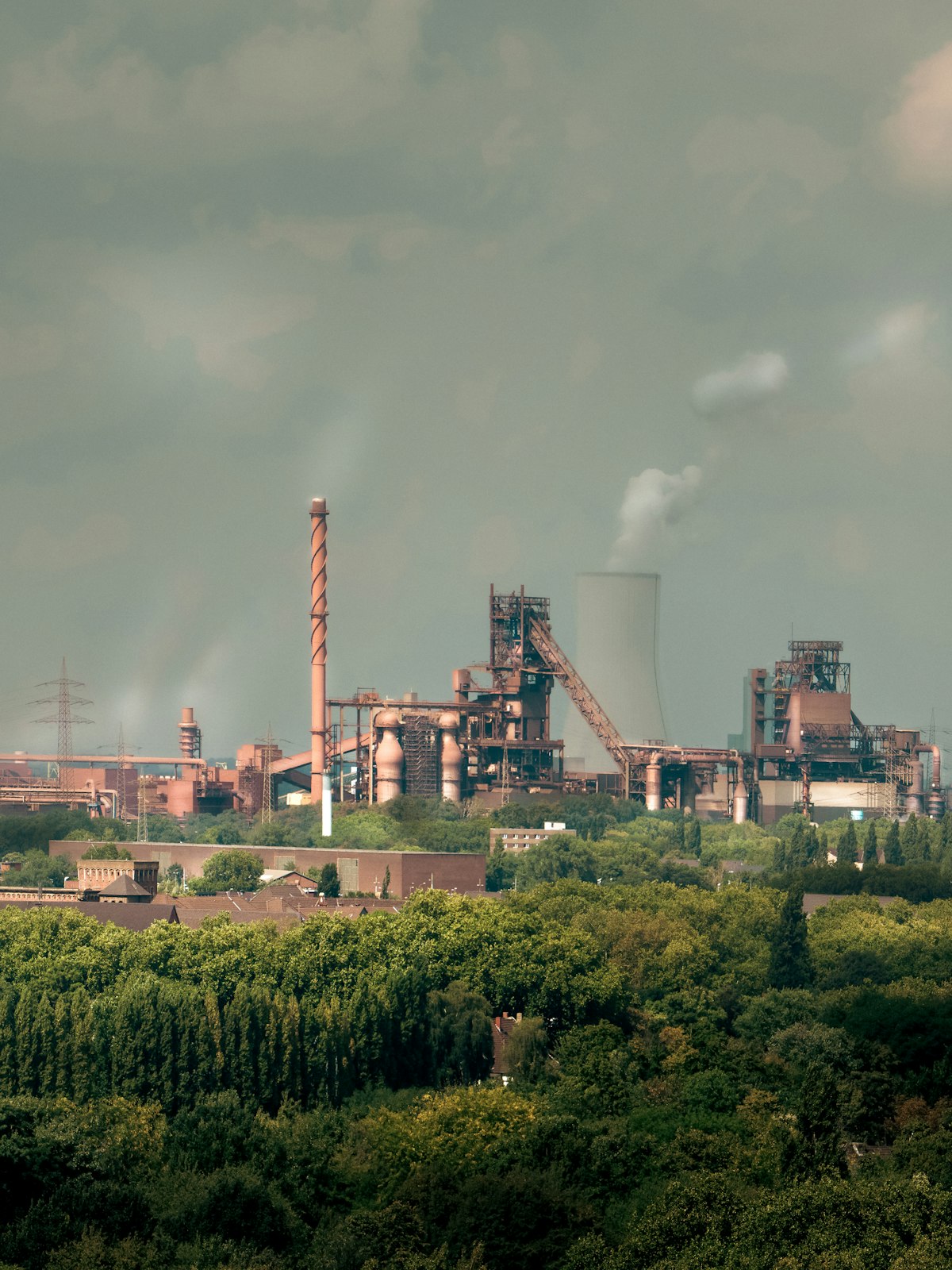
Every quarter, a certified technician climbs the stack, draws a sample, and ships it to a lab. Weeks later, a report lands on the HSE manager's desk. If the numbers look clean, everyone moves on. But what happened in the 89 days between samples?
For most Indonesian factories, the answer is: nobody knows. And that uncertainty is becoming a serious liability.
The current state: quarterly snapshots in a continuous world
Indonesia's industrial sector, from palm oil mills in Riau to cement plants in West Java, has relied on periodic manual sampling for decades. The practice is familiar, relatively cheap upfront, and deeply embedded in how environmental compliance is understood at the plant level.
Under this model, a factory might test its stack emissions four times a year. Each test captures a few hours of operation. The results are compiled into a report submitted to the local environmental agency (DLHK) and, increasingly, to the Ministry of Environment and Forestry (KLHK) through online systems.
On paper, it works. In practice, it creates a dangerous illusion of compliance.
The regulatory shift: PermenLHK 13/2021 and SISPEK
Peraturan Menteri LHK No. 13 Tahun 2021 changed the game. The regulation mandates continuous emission monitoring for specific industrial categories and requires that data be transmitted to KLHK's SISPEK (Sistem Informasi Pemantauan Emisi Secara Kontinyu) platform in near real-time.
The requirement is not aspirational. It specifies sub-hourly data transmission for parameters including particulate matter (TSP), sulfur dioxide (SO₂), nitrogen oxides (NOₓ), and opacity. For industries covered under this regulation, thermal power plants, cement, pulp and paper, steel, and others, quarterly grab samples no longer satisfy the legal standard.
SISPEK is designed to receive data automatically from Continuous Emission Monitoring Systems (CEMS) installed at the source. The system flags exceedances in real time, generates compliance dashboards, and creates an auditable data trail that regulators can access directly.
The gap: what happens between samples
The core problem with manual sampling isn't that the data is wrong, it's that it's incomplete. A stack that passes a 2-hour test on a Tuesday in March tells you almost nothing about what that stack emitted during the other 8,758 hours of the year.
Consider the scenarios that quarterly sampling misses:
What quarterly sampling misses
- Missed exceedances. Boiler startups, fuel switches, and process upsets are the most common sources of emission spikes. These events are transient, lasting 20 minutes to two hours. A quarterly test has near-zero probability of catching them.
- Undetected drift. Gradual degradation of scrubbers, filters, or combustion efficiency creeps. By the time a quarterly sample catches a trend, equipment may have been operating out of spec for months.
- Compliance blind spots. Between tests, there is no feedback loop. Operators can't know whether process adjustments help or hurt. Environmental managers are flying blind.
The cost: more than just penalties
The most obvious risk is regulatory. KLHK has been progressively tightening enforcement, and SISPEK data provides regulators with a direct window into plant performance. Factories that haven't installed CEMS face escalating pressure, from warning letters to operational sanctions.
But the cost of inaction extends beyond penalties. During environmental audits, whether for PROPER ratings, ISO 14001 certification, or buyer ESG due diligence, the absence of continuous data is a red flag. Auditors increasingly expect to see real-time monitoring infrastructure, not just quarterly lab reports.
There's also the operational cost. Without continuous data, plant engineers can't correlate emission levels with process variables. They can't optimize combustion, tune scrubbers proactively, or identify efficiency losses before they become expensive problems. The data that could drive operational improvement is simply never captured.
The alternative: CEMS with automated SISPEK submission
A modern CEMS installation for an Indonesian industrial stack typically includes extractive or in-situ analyzers for the required parameters, a data acquisition system (DAS) that logs readings at sub-hourly intervals, and a secure communication module that transmits data to SISPEK via KLHK's specified protocol.
The MUSA approach integrates these layers into a single stack: sensors on the stack, an edge data logger (MUSA Integrator) that handles local buffering and protocol conversion, and a cloud data platform (MUSA Data Management) that provides redundancy, visualization, and automated SISPEK submission.
In practice, this means:
- Emissions data is captured every 5 to 15 minutes, 24 hours a day, 365 days a year
- Exceedance alerts are pushed to plant managers and HSE teams in real time via dashboard and mobile notification
- Data is automatically formatted and submitted to SISPEK according to KLHK specifications
- Historical data is stored in a queryable warehouse for trend analysis, audit preparation, and regulatory reporting
The result is not just compliance, it's operational intelligence. Plant managers can see how emissions respond to changes in fuel quality, throughput, or ambient conditions. Maintenance teams can schedule interventions based on actual equipment performance rather than fixed calendars.
Where this matters most
The urgency is highest in Indonesia's major industrial corridors. The estates along the eastern corridor of West Java, Cikarang, Karawang, Subang, house thousands of factories under increasing regulatory scrutiny. In North Sumatra and Riau, palm oil and pulp & paper operations face both domestic enforcement and international supply chain pressure.
These are also the regions where MUSA has the deepest deployment experience. Our teams have installed and commissioned CEMS across diverse stack conditions, high-temperature cement kilns, corrosive chemical process stacks, and high-moisture palm oil boiler exhausts. Each installation teaches us something new about the gap between regulatory intent and on-the-ground reality.
The factories that move first won't just avoid penalties. They'll build a data foundation that supports PROPER ratings, ESG reporting, carbon accounting, and eventually, digital twin integration. Continuous emission data is the backbone of all of these.
Conclusion: continuous monitoring as operational advantage
The shift from manual sampling to continuous monitoring is not just a compliance upgrade, it's a fundamental change in how a factory understands its own environmental performance. Quarterly snapshots gave you a grade. Continuous data gives you a dashboard.
For Indonesian industry, the question is no longer whether continuous monitoring is required. The regulation is clear, the enforcement is tightening, and the technology is proven. The question is how quickly your factory can make the transition, and whether you'll treat it as a checkbox or as the operational advantage it actually is.
Ready to move beyond manual sampling?
Talk to our team about CEMS deployment and SISPEK integration for your facility.